

Recently, I read the Foundation series of science-fiction novels, which was written by Isaac Asimov in the 1940s. Except for space travel, we’ve surpassed a lot of the technologies that they describe as happening over 10,000 years in the future.
Take the handheld “calculator pads” or the “complete laundry that can be packed in a small closet and will work entirely automatically.” What about the screen-based “book-viewers?” We can also write essays using just our voice, and project stupidly complex equations onto walls.

All of this runs on computer chips. And a chip starts as basically a slab of sand. You splash it with some light-sensitive chemicals, and shine light to etch patterns on it. Repeat with different materials, and some patterns become microscopic switches called transistors, others the metal wiring between them. Millions of those switches make a chip.
You can now run electricity into it and turn it on and off. That’s literally what computing is. And we don’t have any moving parts!
The first transistor was the size of a finger. But if we make them smaller, we can open up new frontiers, even create some of these science-fiction technologies.1 And over the past 80 years, we made them smaller and smaller and smaller and smaller until the patterns we print are thousands of times thinner than a human hair.
But how?
Let’s look at the light. You can’t just use good ol’ fashioned light. According to some fancy math that caused me to faint the moment I saw it, the smaller the wavelength of the light, the smaller the patterns on the silicon can be. And if we want patterns the size of viruses, you need special light with small wavelengths. The kind that comes out of a crying dragon’s mouth. Extreme Ultraviolet (EUV) light, with a wavelength about 40 times smaller than visible light.
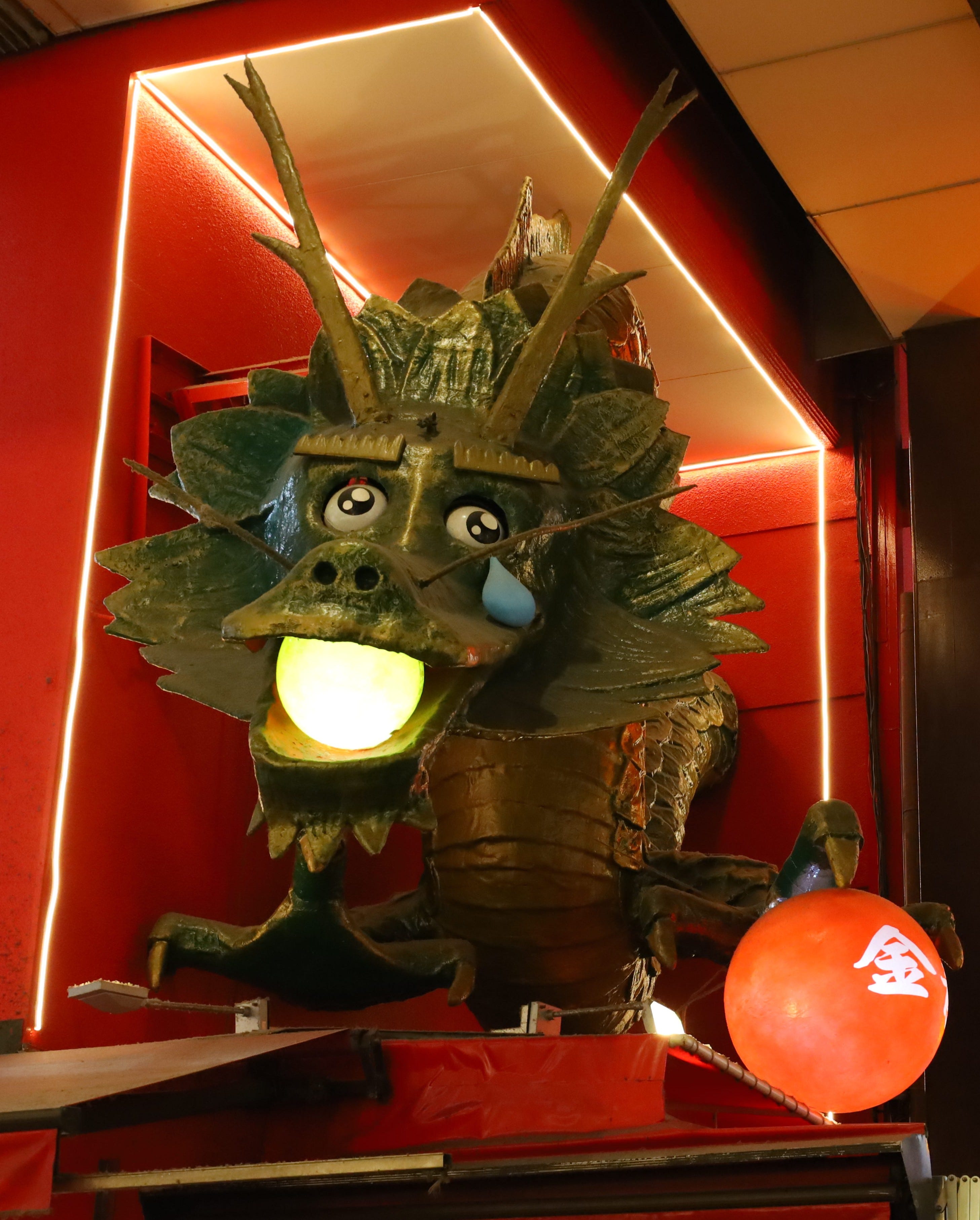
Where do you even get light like that?
You need a machine that ejects 50,000 tin droplets per second, each the size of a white blood cell, at 250kph. They all have to be the same size and speed, so the ejector vibrates at a frequency that breaks the stream into identical droplets. A laser then shoots each tin droplet twice. First to flatten it (allowing for better light absorption), then to vaporize it fully. Each blast is basically a mini supernova, and out comes the EUV light.
But there will be tin atoms that stick to the collection mirror, making it impure. So the chamber has to be filled with hydrogen, which binds with the remaining tin to create another gas. This then gets sucked out and replaced with new gas at the speed of a hurricane to manage heat. Exactly the right amount of oxygen also needs to be sent in to clean the mirrors further.2
From there, mirrors bounce the light onto the silicon. Most materials absorb EUV light, so it has to be bounced off special mirrors onto the silicon. They have to be precise at the atomic level. They have to be precise at the atomic level. For some of them, if one were the size of the world, the tallest bump would only be as tall as a playing card. This is over a thousand times smoother than a regular mirror.
The explosions also misalign the mirrors, requiring a calibration system precise enough to hit a penny on the moon.
The light hits the light-sensitive coating on the silicon and leaves a trace that can be etched and filled with wires etc. Repeat 10-100x, and you have a chip. In this process, the stages of the machine slam back and forth at tens of g’s. It can only be off by 5 silicon atoms. Absolute bonkers.
Any sufficiently advanced technology supply chain is indistinguishable from magic.
You might picture these chips as the work of wizards perfecting a craft, like the smiths folding steel into katanas, the metalworkers of Europe, or the porcelain masters of Korea. But none of them really worked alone either. A katana came out of a whole chain of people: the ones who smelted the steel, the ones who burned the charcoal, the polishers, and the lord who paid for it. The chip is the same kind of thing. It’s just been blown up to a scale no single person, or even a single company, can hold in their head. 5,000 companies supply 100,000 parts for the machine.3 It’s disassembled, put in 7 747s, and shipped. The newest ones cost around $400M each.4
The DoE and Bell Labs funded the early research behind all this back in the 80s and early 90s. Pushing it further got expensive, so the big American chipmakers and the national labs formed a consortium to fund the research. But you also have to turn research into machines. Building lithography machines was its own industry, run by three companies: Nikon, Canon, and a small Dutch company called ASML. Nikon and Canon eventually dropped out, and ASML was the last one standing. And it almost didn’t make it. Prototypes came in the 2000s, but getting them production-ready took years and left customers furious. ASML bet the company on EUV, and only shipped a working machine after Intel, Samsung, and TSMC put in more money.
And the EUV machine is only a tiny part of the chip story! You need a market that supports these massive capital investments, and you need these business leaders who steer and pivot these large organizations. You need state support to kickstart and nurture the private market, but it needs to be hands-off enough to let that market function.5 And of course, all those decisions are being made on the grand chessboard that is geopolitics.6
This big machine, and where its chips are made, are the culmination of politics, economics, business, market conditions, and technology. You need all of that to etch runes thousands of times smaller than a human hair, which underpin all of modern civilization. It’s incredible! But not magic.7
And then you go to Taiwan, you see the exterior of the TSMC factories, and alongside the tree lined boulevard and scooter bike lanes you know the most complex machines mankind has made are churning out the smallest objects. And then it’s just cool.8

The Future of Tribal Knowledge
Thank you for reading! This is a new style of writing for me, and your honest feedback will be most welcome.
Please subscribe below to not miss out on new posts! I am actively working on several posts to publish in Q3, including:
A science fiction short story
Why it might be desirable to get pecked in the head by a bird
A trilogy of posts on Korean culture, infrastructure, and economic development
Sources / further reading
- Veritasium, “The World’s Most Important Machine” (video)
- ASML. “The basics of microchips” (https://www.asml.com/en/technology/all-about-microchips/microchip-basics)
- ASML, “Making EUV: from lab to fab” (https://www.asml.com/en/news/stories/2022/making-euv-lab-to-fab)
- Neil Hacker, “The world’s most complex machine,” Works in Progress (https://worksinprogress.co/issue/the-worlds-most-complex-machine)
- Brian Potter, “How ASML Got EUV,” Construction Physics (https://www.construction-physics.com/p/how-asml-got-euv)
- Chris Miller, Chip War (Scribner, 2022) (this book is awesome)
From ASML, the company that makes the chip machines: “The smaller the features in the patterns that our systems can create, the more transistors manufacturers can fit on a chip, and the more the chip can do.”
The Veritasium video has the full details, with equations and such.
https://www.chosun.com/english/opinion-en/2026/03/15/TRP4CLVIFZCDPG7HAV5FQSFHQY/
https://www.cnbc.com/2025/05/22/exclusive-look-at-high-na-asmls-new-400-million-chipmaking-colossus.html
The USSR had a ton of state support, but all in the wrong ways. The military was the only customer, copying was mandated over invention, and the closed system never grew the supplier base a real market does.
The Chip War book provides an excellent overview of all this, and much, much more.
One can envision a fantasy world where society runs on a bunch of mages inscribing runes on sandstone. The dragons would come in handy here.
[comment 1] Delete the image and caption? It is not ideal to inform my enemies of my vulnerability to heat.
I learned something new and enjoyed reading!
Well done. A few things I thought about while reading:
-Man makes CPU from scratch: https://www.youtube.com/watch?v=vuvckBQ1bME
-If you're interested in science fiction, an especially relevant piece to consider reading is "Dune" by Frank Herbert. In the book, humans fought a war against AI machines(way before the start of the book) that teaches the characters in the universe to not delegate their thinking to machines, and instead to cultivate their own human minds and abilities to their fullest potential
-This piece in general also reminds me of the work of John Wilson, see here: https://www.imdb.com/title/tt10801534/
Great read and looking forward to your next post!
-Alejandro